General Spay/Neuter Guidelines
- Kittens must be at least 12 weeks old or weigh at least 3 pounds.
- Puppies must be 8 weeks old. It is recommended that they go to surgery with at least 2 sets of core vaccinations. Core vaccines are given in a series of three sets, when your puppy is 8, 12, and 16 weeks old and includes: rabies vaccination, canine distemper, canine hepatitis or adenovirus-2, and canine parvovirus, but that is left up to the owner.
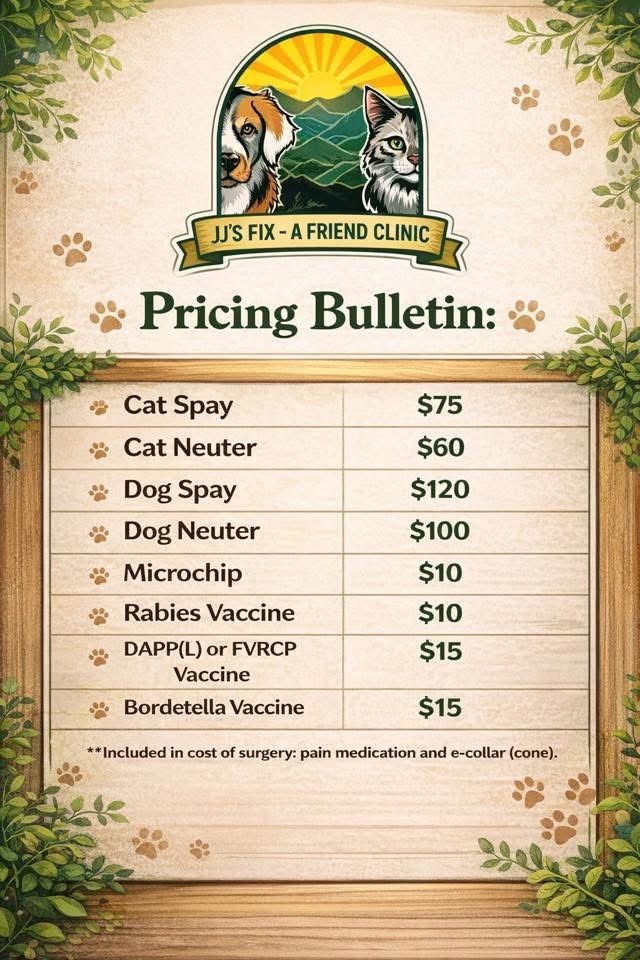
- The costs at JJ’s Clinic are shown below:
Sign up for Low Cost Spay/Neuter
- REQUEST an appointment with this link:
https://clinichq.com/online/402120e4-d870-410f-b076-33e69c005ac7 - Be sure that your email address is entered correctly.
- Be prepared to attach a file with proof of rabies vaccination, otherwise your
pet will receive a rabies vaccine the day of surgery for $10. This is a state law requirement. - Staff will REVIEW the appointment; we will reach out to you if we need to
make changes. You do not have an appointment until we confirm it. Once we
confirm it, you will then receive your pre-surgical consent form as well as
instructions for the day of surgery. - ou need to pre-pay for your appointment at least 48 hours in advance. This is to
ensure a smooth surgery day for you and your pet. On surgery day we want to
focus on the care of your pet and going over post-op care instructions at the end
of the day. There is a payment tab at the link provided above. Anyone who does not have internet access can come to the shelter and fill out paper forms. You may also bring cash or check to the shelter, but this must be done 48 hours in advance of your appointment. The cost of the surgery includes post-op medication and an e-collar (cone). - We currently have a grant to help with Trap-Neuter-Return (TNR) for stray cats. They
will receive an ear tip, Rabies shot and must be returned to their original location. If you
are willing to trap, transport, and return your ferals you may request an appointment with
the online form and write TNR in the Notes section. Also include the area of the county in which the stray cat/cats reside and the total number of cats needing to be spayed/neutered. - You will receive a post op report that has the surgery information, post op instructions as well as any concerns noted during surgery, i.e. dental concerns, fleas…etc. The post op instructions are shown below if you would like to read them ahead of time.
POST OPERATIVE KEY POINTS
- DO NOT ALLOW YOUR PET TO LICK HIS/HER INCISION
- USE CONE OR SURGERY SUIT
- NO RUNNING, JUMPING OR PLAYING – LEASH WALKS ONLY, USE A CRATE
- NO BATHS OR SWIMMING FOR 10 DAYS
- You must restrict the animal’s activity for the next ten days to allow the tissue time to heal and avoid causing the incision to open. Cats should stay indoors. All dogs should go out on a leash to
urinate/defecate and then return inside to rest. Keep the incision site dry; do not bathe or apply topical ointment during the recovery period. - Keep males away from unspayed females for 30 days. Keep females away from unneutered males for seven days. Be prepared to keep pets separate during the recovery period.
- Check the incision site twice daily. Females should have no drainage; redness and swelling should be minimal. The incision for male dogs is prescrotal, the scrotum will often swell after surgery making it appear that there are still testicles. This swelling should reduce each day. Small amounts of drainage/discharge are normal for up to three days. Too much activity causes increased drainage, so activity restriction is very important. Do not allow the Animal to lick or chew at the incision. If this occurs, an Elizabethan collar (CONE) or a surgery suit MUST be applied to prevent additional licking/chewing that could cause infection.
- Appetite should return gradually within 24 hours of surgery. Do not change the Animal’s diet at this time, and do not give them junk food, table scraps, milk, or any other people food during the recovery period. Feeding them their regular diet will help avoid gastro-intestinal upset.
- Minimal redness and swelling of the surgery site should resolve within several days, but if they persist longer, please call our office at 828-682-3444. After office hours (M-TH 8-5), please call your regular veterinarian or MedVet, VEG, or SAVES (local emergency hospitals in Asheville). You should seek veterinary care immediately if you notice any of the following: pale gums; depression; unsteady gait; loss of appetite or decreased water intake; vomiting; diarrhea; discharge or bleeding from the incision; difficulty urinating or defecating; labored breathing. We will make every reasonable effort to treat at OUR CLINIC, at minimal cost, any post-operative complications resulting directly from the surgery, if the above post-operative instructions are followed in full. Your regular veterinarian must address illnesses or injuries that are not a direct result of surgery.
- ***Do not give human medication to the animal. It is and can be fatal. If the animal received a vaccine at our clinic other than rabies, please discuss a “booster” vaccine with your regular veterinarian. Canine distemper/parvo vaccine & feline distemper vaccine all need to be “boostered” three to four weeks after administration of the first vaccine for maximum effectiveness.
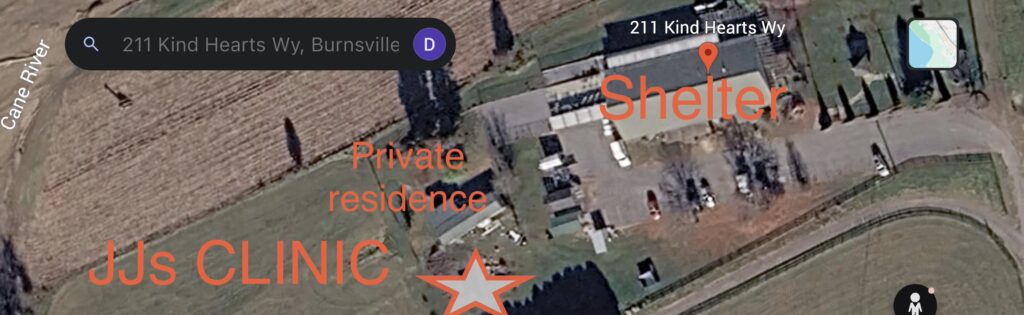
Find us at 211 Kind Hearts Way, Burnsville, NC 28714. Travel past the shelter and you will see the clinic as a stand alone building to the left of the shelter.
Email – Jjsfixafriend@yanceyhumanesociety.org
Phone – 828-208-3444